
Don’t follow trends. Innovate from them.
Trend reports are everywhere. But knowing what is changing is not the same as knowing what to do about it.
Every year, organisations are presented with new consumer trends, technology trends, sustainability trends and predictions about what will shape the years ahead.
AI. Longevity. Repair. Resale. New forms of ownership. Changing expectations of work. Resource scarcity. Regenerative thinking. New communities and new ways of consuming.
Interesting? Absolutely.
But the strategic question is not simply: What are the trends? The real question is how we can use emerging change to innovate one step ahead – creating products, services, experiences and business opportunities that respond to needs that are only beginning to take shape but will be growing in the future.
That is where trend research becomes Trend Innovation.
From observing change to creating opportunities
A trend is not simply something that is fashionable right now. Trends are patterns of change that influence what a growing number of people think, expect and do. And when expectations change, markets change with them.
New needs emerge. Existing needs are expressed in new ways. New technologies make previously impossible solutions possible. Regulation changes the rules of the game. Behaviours that once seemed marginal gradually become mainstream.
This is why trend research can be such a powerful starting point for innovation. The objective is not to predict one specific future. Nobody can. The objective is to become better at identifying the changes that matter early enough to explore where they might lead – and what new opportunities they could create.
For companies, that creates the possibility of moving from reacting to change towards anticipating it and innovating ahead of it.
Start with Small Data
One of the most interesting places to start is often not with the big numbers, but with the small observations.
Brand strategist Martin Lindstrom uses the concept Small Data to describe seemingly insignificant behavioural observations that can reveal unmet needs and point towards much bigger changes. Within futures and trend research, a related concept is Weak Signals: Early and often ambiguous signs that something new may be emerging, long before it appears in mainstream behaviour or statistics.
It could be an unusual new service, a small shift in everyday behaviour, a start-up approaching an old problem differently, a pilot project, a fringe product or simply something you observe that makes you stop and think: That’s interesting. Why is that happening?
One observation on its own may mean very little. But when several surprising observations begin pointing in the same direction, they can indicate a more fundamental shift.
Imagine, for example, that libraries begin lending tools rather than only books. Repair cafés appear in cities. Consumers increasingly buy refurbished electronics. New regulation strengthens the right to repair. Manufacturers begin designing products that can be disassembled.
Seen individually, these are separate developments. Seen together, they may signal a larger shift in our relationship with products – from replacement towards repair, from ownership towards access and from linear consumption towards circularity.
That is where the innovation potential starts to become interesting.
Connect the dots
Identifying an emerging trend is only the first part of the work. To understand whether it really matters, we need to look at the forces behind it.
Trends are shaped by changes in politics, economics, culture, technology, legislation and the environment. These factors form the wider context in which a business operates – almost like a game board where the rules are constantly changing.
A new regulation can suddenly make one business model less attractive and another more relevant. A technological breakthrough can remove barriers that previously made an idea impossible. Resource scarcity can fundamentally alter cost structures, while changing cultural values can transform something previously perceived as inconvenient into something desirable.
Understanding a trend therefore means looking beyond its visible manifestations. What is driving this development? Which forces could accelerate it – or slow it down? Who is already experimenting in this space? And what might happen if behaviours that currently sit at the margins become mainstream?
When we begin connecting these dots, trends become much more than observations about the future. They become strategic input for deciding where a company might move next.
From trend mapping to Trend Innovation
This is where trend research becomes really useful. The purpose is not to produce another beautifully designed trend presentation that is interesting to look at but difficult to act upon. The purpose is to translate change into new possibilities.
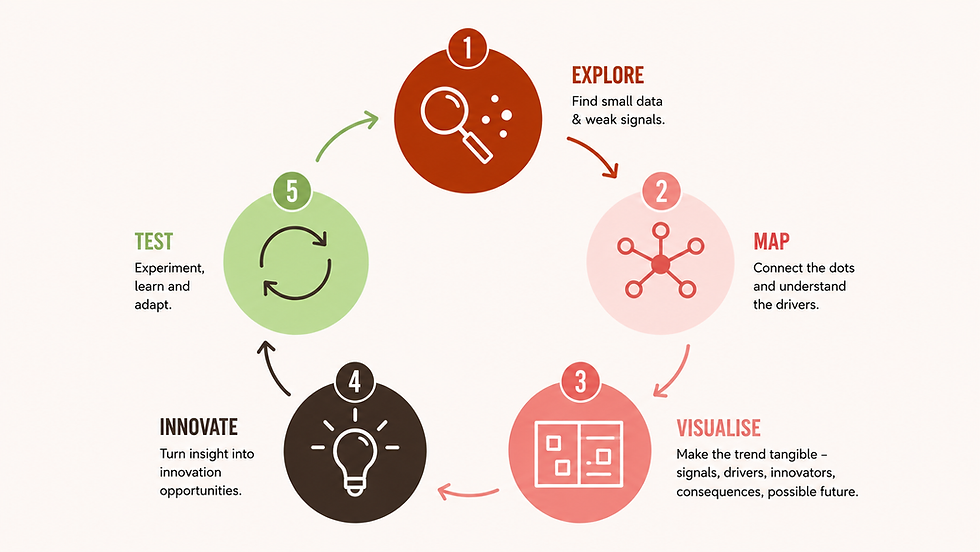
In my work with Trend Innovation, I use a process that moves from exploring signals and emerging patterns, to understanding the wider context and drivers behind them, visualising the most relevant trends and finally translating them into potential innovation opportunities.
One of the tools I use is a Trend Cartogram. It creates a shared picture of a trend by bringing together the signals we are seeing, the forces driving it, the innovators already moving within it, the possible consequences and the directions in which it could develop.
Once this picture becomes clear, the conversation changes. Instead of merely asking What does this trend mean?, we can start asking what we could actually do with it.
How could an existing product evolve? Could a new service respond to an emerging behaviour? Could a different partnership unlock new value? Might the trend create opportunities for a new customer experience, a new revenue stream or even a different business model?
This is the move from trend insight to trend innovation.
Innovation does not always have to be disruptive
Working strategically with trends does not necessarily mean reinventing an entire company.
Some of the most interesting opportunities can begin at the edges of the existing business: a new service, an add-on to a product, a collaboration with an unexpected partner, a pilot project or a new way of repairing, sharing, returning, upgrading or accessing a product.
These smaller initiatives can act as strategic experiments. They allow companies to explore an emerging direction, learn from customers and partners and test whether a trend has real relevance before committing to a much larger transformation.
That makes Trend Innovation useful not only when developing completely new concepts, but also when asking a much more pragmatic question:
What could we start experimenting with today that prepares us for the world that is emerging tomorrow?
The future is already leaving clues
I have worked with trends, consumer behaviour, branding and innovation for many years, and this is still what fascinates me most about the field.
The future rarely arrives completely unannounced. Small pieces of it are already around us – in new behaviours, technologies, frustrations, start-ups, subcultures, regulations and experiments. Some will disappear again. Others will grow into changes that fundamentally alter categories and markets.
The skill is not predicting exactly which one will become the next big thing. The skill is learning to notice change, understand what is driving it, connect the dots and translate what you see into new possibilities. Because companies that understand change early don't just become better at preparing for the future.
They gain the opportunity to innovate one step ahead – and potentially help shape what comes next.
Trend Innovation is part of The Brand Value Circles
Trend Innovation is one of the tools in The Brand Value Circles, my strategic toolbox for developing brands and businesses that create value for the company, its customers, society and the world around them.
The complete toolbox consists of 15 canvases covering the journey from insight and innovation to business development, brand building and engagement. Trend Innovate sits within the Brand Value Imagine circle and can be used as part of the complete process – or independently when an organisation wants to explore emerging change and translate it into new innovation opportunities.
You can read more about The Brand Value Circles, the book and the toolbox at:
Want to explore what trends could mean for your business?
If you are curious about how Trend Innovation could be applied to your specific business, challenge or category, feel free to reach out.
FutureTribe offers Trend Innovate workshop sessions where we explore emerging trends and translate them into concrete innovation opportunities.
Or simply get in touch for an informal conversation about what a Trend Innovation process could look like for your organisation.
Let’s turn change into opportunity.
Comments